


It multiplies the power. Divide the rack.
The Math Behind a Fixed Installation.
4
channels
Low-impedance Class D
3
levels
power
1
only
chassis
All specifications for the LUX series are measured with all four channels operating simultaneously.

multiply
multiply
which adds to the project

Every watt you add to a sound project requires space, wiring, and time. More power has always meant more equipment.
The LUX SERIES breaks this pattern.

the power
Up to 4 × 700 W RMS at 4 Ω in a single chassis. The entire series specifies its power output with all four channels operating simultaneously.
channels
Four independent Class D channels, configurable in stereo, parallel, or bridge mode. The amplifier adapts to the project—not the other way around.
areas
Four zones, each with its own gain, sensitivity, and filtering. Each space sounds exactly as it should—all from a single unit.
outings
Low-impedance outputs optimized for 4 Ω or 8 Ω, with removable Euroblock or XLR connectors. And when a load demands more, two bridged channels.
what sounds like…
Background music, voice announcements, priority alerts, and bass boost with built-in LPF/HPF filters. One amplifier for the entire system.
divide
Do the math. You have plenty of rack space to spare.
A full rack isn’t just a space issue—it means hours of wiring, configuration, and maintenance. Removing equipment has always meant sacrificing performance.
The LUX SERIES breaks this pattern.
the rack
Four power channels in a single 19-inch chassis measuring 430 × 95 × 370 mm and weighing less than 8 kg. Where multiple stages were once required, one is now sufficient.
the wiring
A single network connection and removable Euroblock connectors that are set up outside the rack. It is mounted pre-wired, and the GND lift prevents ground loops without any workarounds.
the times
Input and output gain, filter, cutoff frequency, and operating mode, channel by channel. Four zones configured in a single setup.
maintenance
maintenance
One piece of equipment to check, one set of protections to monitor: thermal, short-circuit, overcurrent, overload, and DC at the output. Fewer parts in stock and fewer variables when something goes wrong.
consumption
Class D with automatic standby after 15 minutes: 23.4 W when there is no activity, without requiring anyone to turn anything off. Variable-speed forced cooling—only the air that’s needed.
divide
Do the math. You have plenty of rack space to spare.
A full rack isn’t just a space issue—it means hours of wiring, configuration, and maintenance. Removing equipment has always meant sacrificing performance.
The LUX SERIES breaks this pattern.

Nothing is left over. Nothing is missing.
In the LUX SERIES, there isn’t a single control too many or a single connection too few: just what an installer needs to touch, right where they need to touch it.
Every design decision answers a very specific question: Does this save the installer time?

Every control, every connector, and every millimeter of the LUX SERIES has been designed with the installation, adjustment, and maintenance of a rack in mind.


Nothing is left over. Nothing is missing.
In the LUX SERIES, there isn’t a single control too many or a single connection too few: just what an installer needs to touch, right where they need to touch it.
Every design decision answers a very specific question: Does this save the installer time?
Every control, every connector, and every millimeter of the LUX SERIES has been designed with the installation, adjustment, and maintenance of a rack in mind.
LUX Series · Professional 4-channel Class D amplifiers for permanent installations. Three power ratings, built-in filters, and an emergency input. Choose your LUX model.
Four channels. As many configurations as there are projects.
The LUX SERIES consists of professional Class D amplifiers with 4 independent channels and low-impedance output, designed for fixed installations that require a combination of power, zone control, configuration flexibility, and reliable operation.

The power ratings are specified with all channels operating simultaneously, a particularly important factor in professional installations, where the amplifier must maintain its performance when all four zones are active.
LUX SERIES
A single quality standard for the entire series.
The power listed is the power output
All specifications for the LUX series are based on all four channels operating simultaneously. There is no drop in performance when the system is operating at full load with all four zones active.
01
FLEXIBILITY
Stereo, parallel, or bridge mode
Outputs optimized for 4 Ω or 8 Ω loads. The same amplifier can be configured for multiple independent zones, a distributed signal, or a load that requires more power.

Operation 01 – STEREO | 02 – PARALLEL | 03 – BRIDGE
02
Acoustic Control
LPF, HPF, or Full-Range Filters
With selectable cutoff frequencies of 40, 80, or 120 Hz. Independently adjustable gain and sensitivity for integration with mixing consoles, matrices, processors, and control systems.
This translates to:
Full Range: for full-range speakers.
HPF: to protect small speakers or satellite speakers from low frequencies.
LPF: to power subwoofers.

03
Integration
Priority Emergency Input (Line or 100 V)
To interrupt regular programming and broadcast announcements. Mute function via contact closure. XLR and Euroblock connectivity. Ground-lift switch.
This translates to:

04
Reliability
Level and Power Limiter
Thermal protection, short-circuit protection, overcurrent protection, overload protection, and DC voltage protection on the outputs. Auto standby after 15 minutes. Variable-speed forced cooling.
This translates to:

*
Bridge Mode
Boost a specific area without adding another amplifier
Bridge two channels to power a subwoofer or a high-power speaker, and use the remaining two channels for background music throughout the rest of the venue. All from the same unit and with built-in LPF filters, without adding a monophonic amplifier to the rack.
This translates to:

Example of Intelligent Asymmetric Reinforcement
Use channels C and D for background music, and combine channels A and B to power a subwoofer in the main room. All from a single unit and using the built-in LPF filters, without adding extra mono stages.
And much more
Other features that set us apart
Professional Connectivity
The XLR and Euroblock inputs allow you to choose between:
- Quick, removable connection for permanent installation.
- Professional XLR connectors for racks, mixers, or audio equipment.
Efficient Operation
Class D technology and a switching power supply enable high power output in a 19-inch rack-mountable unit. All three models feature variable-speed forced cooling and share the same dimensions: 430 × 95 × 370 mm.
Energy Savings
Auto standby after 15 minutes reduces power consumption when there is no activity, without requiring the user to manually turn off the system.


What is it?
It is the entry-level model in the LUX series, but it offers the same control, connectivity, filtering, emergency, and protection features as the higher-end models.
Professional four-channel Class D amplifier, capable of delivering:
- 120 W RMS per channel at 8 Ω.
- 240 W RMS per channel at 4 Ω.
- 480 W RMS in bridge mode at 8 Ω.
Primary use
It is designed for installations where multiple channels or independent zones are needed, but high power per speaker is not required.
It is particularly well-suited for:
- Background music.
- Reproduction of advertisements and text.
- Sound systems for small and medium-sized rooms.
- Systems with low- and medium-power speakers.
- Facilities divided into several zones.
- Corporate and Educational Audiovisual Systems.
When should you use it?
It should be recommended when:
- The power requirement does not exceed 120 W per channel at 8 Ω.
- You need to connect a 4 Ω load and have up to 240 W per channel.
- There are up to four separate areas.
- The priority is to include all the features of the LUX series without oversizing the system.
- Emergency alerts or remote muting need to be integrated.
- It is primarily used for background music, speech, or audiovisual content at moderate volume levels.
- The goal is to keep fuel consumption and investment lower than those of higher-powered models.
W RMS (8 Ω)
Just the right amount of power for four zones. No need to pay for what you won’t use.
W RMS (4 Ω)
Lower the impedance, and the figure doubles—with all four channels running.
W RMS in bridge mode (8 Ω)
When an area needs more, two channels join forces and get the job done.
What is it?
It is the most balanced model in the lineup, falling between the efficiency of the LUX-4120 and the high power of the LUX-4350.
A professional, mid-power, four-channel Class D amplifier capable of delivering:
- 200 W RMS per channel at 8 Ω.
- 400 W RMS per channel at 4 Ω.
- 800 W RMS in bridge mode at 8 Ω.
Primary use
It is designed for medium-sized installations that require greater dynamic range, higher-powered speakers, or sound pressure levels higher than those typically found in background music systems.
It is particularly well-suited for:
- Music and voice systems.
- Multipurpose audiovisual facilities.
- Professional mid-power speakers.
- Areas with different power requirements.
- Systems with bass boost.
- Projects that require room for future expansion.
When should you use it?
It should be recommended when:
- 120 W per channel is not enough.
- Up to 200 W per channel at 8 Ω or 400 W per channel at 4 Ω is required.
- The system plays music at a medium or high volume.
- It is necessary to have a greater dynamic range to prevent the amplifier from constantly operating near its limit.
- Areas with background music are combined with others that are more demanding.
- You may need to use a pair of channels in bridge mode to power a higher-wattage speaker or subwoofer.
- We are looking for a versatile solution that can be reused in different projects.
W RMS (8 Ω)
The model that covers most of the projects that come through the door.
W RMS (4 Ω)
Headroom for music peaks, not for the limiter.
W RMS in bridge mode (8 Ω)
A powered subwoofer without adding another component to the rack.
What is it?
It is designed for demanding professional installations, high-power speakers, subwoofer systems, and applications that require high sound pressure levels or a wide dynamic range.
It is the most powerful model in the LUX series, with four Class D channels capable of delivering:
- 350 W RMS per channel at 8 Ω.
- 700 W RMS per channel at 4 Ω.
- 1,400 W RMS in bridge mode at 8 Ω.
Primary use
The ideal solution for professional systems, subwoofers, and installations that require high sound pressure levels and a wide dynamic range.
Its primary use is for amplifying high-performance systems in fixed installations:
- High-powered professional speakers.
- Subwoofers.
- Sound reinforcement systems.
- Large or acoustically challenging spaces.
- Music apps with more dynamic content.
- Systems designed to concentrate a high amount of power into a single multichannel amplifier.
When should you use it?
It should be recommended when:
- More than 200 W per channel at 8 Ω is required.
- Up to 700 W per channel is required when operating at 4 Ω.
- High-power speakers are used.
- The installation requires high sound pressure levels.
- A wide dynamic range is required for musical peaks.
- They power professional subwoofers or full-range speakers.
- The goal is to reduce the number of amplifiers installed.
- Up to 1,400 W RMS must be achieved in bridge mode.
- The facility may be expanded or face increased demands in the future.
W RMS (8 Ω)
True sound pressure in large venues. All four channels at once.
W RMS (4 Ω)
2,800 W RMS total at 4 Ω in a single chassis.
W RMS in bridge mode (8 Ω)
Subwoofers and continuous amplification without an additional monaural amplifier.




“It’s easy to draw four zones on a chassis. The interesting part comes when all four channels are operating at the same time.”
That is why the power ratings for the LUX series are specified with all four channels operating simultaneously. This is not the power rating for a single channel; it is the power the unit actually delivers in a real-world installation.
“And that’s why all three models share everything: filters, bridge mode, emergency input, and protections. All three come fully equipped. The only difference between them is the wattage, so you can choose based on power rather than features.”

Pablo Calvín
Product Design Manager

Which model should I choose?
Diagnostic and Application Matrix
All three models share the same features.
The choice between the LUX-4120, LUX-4200, and LUX-4350 should be based primarily on:
| Criterion | LUX-4120 | LUX-4200 | LUX-4350 |
|---|---|---|---|
| Power per channel at 8 Ω | 4 × 120 W RMS | 4 × 200 W RMS | 4 × 350 W RMS |
| Power per channel at 4 Ω | 4 × 240 W RMS | 4 × 400 W RMS | 4 × 700 W RMS |
| Bridged at 8 Ω | 480 W RMS | 800 W RMS | 1,400 W RMS |
| Project type | Small to medium | Medium | Medium to large |
| Dynamic headroom | Moderate | High | Very high |
| Positioning | Smart efficiency | The integrator's standard | Maximum power density |
As a general rule, the LUX-4200 is the most well-rounded model to use as a general reference. The LUX-4120 should be used to optimize lower-power projects, and the LUX-4350 for high-demand installations.
What is your sound project like?
| Criterion | LUX-4120 | LUX-4200 | LUX-4350 |
|---|---|---|---|
| Project type | Small to medium | Medium | Medium to large |
| Main use | Background music, announcements and speech | Mixed, all-purpose use | Music and high-demand applications |
| Background music | Excellent choice | Suitable, although it may be oversized | Only recommended if there are other high-power requirements |
| Announcements and speech | Excellent choice | Excellent choice | Suitable, although it usually offers more power than needed |
| High-level music | Moderate use | Recommended | Highly recommended |
| Loudspeaker power | Low or medium | Medium or medium-high | High |
| Use with professional loudspeakers | Limited by available power | Suitable for most configurations | Especially recommended |
| Use with subwoofers | Small, with moderate demand | Medium-power subwoofers | High-power subwoofers |
| Sound pressure level | Moderate | Medium to high | High |
| Dynamic headroom | Moderate | High | Very high |
| Zone variety | Best when zones have similar requirements | Very well suited to combining different zones | Suitable when several zones require high power |
| Expansion capacity | Limited if the system is already running close to its available power | Good headroom for future expansion | Maximum room for power growth |
| Power utilization | Very high in small and medium installations | Optimal balance between available power and utilization | Best utilization in demanding installations |
| Risk of oversizing | Low | Medium in simple installations | High in small or low-demand projects |
| Budget priority | The best option when cost is the priority | Mid-range investment with greater power headroom | Justified when the additional power is genuinely needed |
| Application flexibility | High | Very high: the most versatile model | Very high within demanding applications |
| Power concentration | Moderate power in a single unit | High power with good overall balance | Maximum power concentrated in a single amplifier |
| Selection criterion | Choose when you want to meet the requirement without oversizing | Choose when you want the best overall balance | Choose when power and headroom are the priority |
| Installation profile | Retail, offices, classrooms, hospitality and small spaces | Hotels, education, corporate, sports facilities and multi-zone projects | Auditoriums, large venues, demanding sports facilities and events |


Do you have any questions?
If you have any questions or concerns, please don’t hesitate to contact us. We’re here to help you!

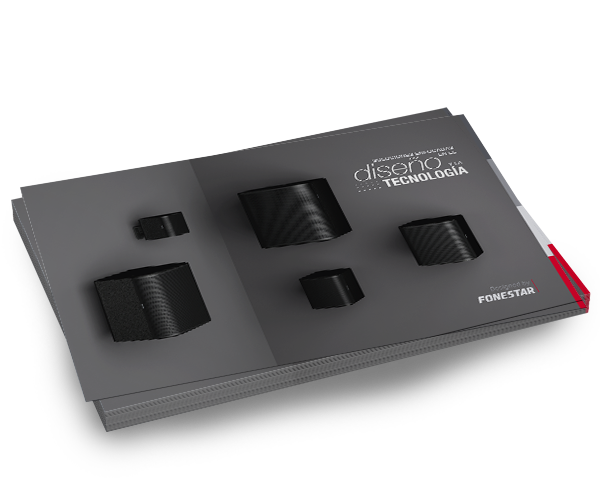
In this brochure, you will find a selection of solutions focused on sound design and technology developed under European engineering criteria, designed to integrate naturally into spaces where detail matters and standards of quality and durability are essential.
Déjanos tus datos para acceder al contenido completo y descubrir cómo Design by Fonestar aporta valor a instalaciones que exigen rendimiento, diseño y fiabilidad a largo plazo.
